We Were Soldiers Once...and Young: Ia Drang - the Battle That Changed the War in Vietnam by Harold G. Moore & Joseph L. Galloway
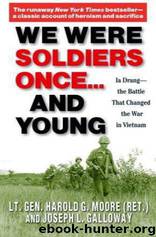
Author:Harold G. Moore & Joseph L. Galloway [Moore, Harold G. & Galloway, Joseph L.]
Language: eng
Format: epub
Tags: History, American History
Publisher: Presidio Press
Published: 2004-11-15T07:00:00+00:00
POLICING THE BATTLEFIELD
Nothing except a battle lost can be half so melancholy as a battle won.
--The Duke of Wellington, in a dispatch from Waterloo, 1815
In our Mad Minute we had swept the area outside our perimeter. Now I ordered a sweep inside our lines. At 7:46 a.m. the reserve elements, the recon platoon, and the survivors of Charlie Company began a cautious and very deliberate patrol of the territory enclosed by our troops. I ordered them to conduct the sweep on hands and knees, searching for friendly casualties and North Vietnamese infiltrators in the tall elephant grass. They also checked the trees inside the line of foxholes closely. By 8:05 a.m. they were reporting negative results.
At 8:10 all units on line were ordered to coordinate with those on their flanks and prepare to move five hundred yards forward on a search-and-clear sweep, policing up any friendly casualties and all enemy weapons. There was a long delay before this dangerous but necessary maneuver could begin. Radio checks, ammo resupply, coordination with flanking units--all these took time for men who were slowing down mentally and physically after forty-eight hours of constant tension and no sleep. My last rest had been those five hours of sleep the night of November 13. I could still think clearly but I had to tell myself what I intended to say before I opened my mouth. It was like speaking a foreign language before you are completely fluent in it. I was translating English into English. I had to keep my head, concentrate on the events in progress, and think about what came next.
The sweep began at 9:55 a. m., and Myron Diduryk's men had moved out only about seventy-five yards when they met enemy resistance, including hand grenades. Lieutenant James Lane, Diduryk's 2nd Platoon leader, was seriously wounded. I stopped all movement immediately and ordered Diduryk's company to return to their foxholes. Sergeant John Setelin, his burned arm still throbbing, was unhappy. "That morning we were ordered to sweep out in front of our positions. I didn't like that. At night I felt fairly safe because Charlie couldn't see me and I was in that hole and didn't have to get out. But when daylight came I wanted to cuss Colonel Moore for making us go outside our holes. We were told to make one last sweep, a final check around. During that sweep, Lamothe and I brought in one of the last of our dead. Big man, red hair, handlebar mustache. We found him next to a tree, sitting up, his rifle propped up on another tree. One round through his chest, another through the base of his throat. We got him back, running and dragging him."
Lieutenant Rick Rescorla, as usual, was in the middle of it all. "I led my platoon forward into the silent battlefield. We followed a twisting path through the clumps of enemy dead. Fifty yards out we crossed a clearing and were approaching a group of dead NVA machine gunners. Less than seven yards away the enemy head snapped up.
Download
This site does not store any files on its server. We only index and link to content provided by other sites. Please contact the content providers to delete copyright contents if any and email us, we'll remove relevant links or contents immediately.
| Africa | Americas |
| Arctic & Antarctica | Asia |
| Australia & Oceania | Europe |
| Middle East | Russia |
| United States | World |
| Ancient Civilizations | Military |
| Historical Study & Educational Resources |
The Radium Girls by Kate Moore(12094)
100 Deadly Skills by Clint Emerson(4972)
Rise and Kill First by Ronen Bergman(4838)
The Templars by Dan Jones(4736)
The Doomsday Machine by Daniel Ellsberg(4551)
The Rape of Nanking by Iris Chang(4257)
Killing England by Bill O'Reilly(4042)
Stalin by Stephen Kotkin(4006)
Hitler in Los Angeles by Steven J. Ross(3981)
12 Strong by Doug Stanton(3579)
Hitler's Monsters by Eric Kurlander(3385)
The Code Book by Simon Singh(3251)
Blood and Sand by Alex Von Tunzelmann(3240)
Darkest Hour by Anthony McCarten(3161)
The Art of War Visualized by Jessica Hagy(3043)
Hitler's Flying Saucers: A Guide to German Flying Discs of the Second World War by Stevens Henry(2777)
Babylon's Ark by Lawrence Anthony(2718)
Tobruk by Peter Fitzsimons(2559)
The Second World Wars by Victor Davis Hanson(2554)
